SWELL by Vandy Vape

The TOTAL Mod?

RINCOE MechMan 228

BOX for RAMBO?

VooPoo X217

HOT SHOTS (of juice)

What 18650 battery for electronic mod?

Useful capacity of 18650 batts in electronic mod

Aegis SOLO

Geek Vape in GOOD SHAPE!

Saturday, 27 June 2015

Resistance measurements - facts and myths

Again and again we see the questions such like "how many wraps shall I do to get a 1 ohm?". Often the answer is "buy a multimeter" and then sometimes somebody answer "there is NO WAY to measure such low coil resistance by use of regular, cheap multimeter!". Is it true? Let's see...

I wrapped some microcoil on the MutationX atomizer and will measure its resistance by use of several multimeters. Starting from expensive, calibrated meter by Keithley. But first...

Measuring the resistance by use of multimeter first we have to know (and take into account) resistance of the measuring system. 
(it means: resistance of probes/cables and internal resistance of meter)

We can do it in a very simple way: just performing a regular resistance measurement of shorted test probes:


As we can see the resistance of measuring system is 0.15 ohm. So it will be added to the each measured real resistance

Now let's see what about the atomizer:


OK, we get 0.75 ohm. Knowing that 0.15 ohm is from meter we can calculate that the resistance of the coil is 0.6 ohm.


Fine, but what with budget meters? Let's take something around 30$...

Cables first:


Here we get 0.4 ohm in bonus. And the atomizer:


So after deducting we somehow get also 0.6 ohm.


But wait a second... I also have the cheapest multimeter from FastTech, for about 10$.

Cables:


Atomizer:


Lets calculate... What is the result? Really? 0.6 ohm again!


Och! I have also SXmini at hand:


And we also get 0.6 ohm (after rounding)!

So we shouldn't look for problems where there are none!
 Today's electronics is such advanced that even multimeter for 10$ will be able to measure our atomizers with accuracy of 0.1 ohm - this is not rocket-science.

Of course there are limits - the main is resistance of measuring system: it is not proper to measure object whose resistance is lower than the resistance of the measuring system :-) So my deliberations are dedicated to resistance above 0.4 ohm (this is typical resistance of cheaper multimeters).

Friday, 12 June 2015

DANI Extreme v2 by DICODES

DANI Extreme v2 was released by Dicodes together with 2380 mod (actually 1-2 weeks earlier). And they are twins. 2380 is is a little bigger and more powerful but the rest of technical specification is the same. I described the 2380 firstly, but some features have been omitted (e.g. "heater protection" modes) so in this post I'd like to present the full, deep review of second version of DANI mod. Most of features (actually ALL) of Extreme v2 is the same like in 2380.


 1. The FINISH.

It's just PERFECT. Really perfect, with no cons. Everything is matched perfect, and perfectly finished. The mod is 22mm monolith without frills.


 2. FEATURES.

Here is quite good:
* power: 5-40W,
* coil resistance: 0,2 - 3,5 ohm,
* coil temperature control,
* "hot-start" modes,
* "heater protection" modes,
* vaping statistics.

For me it is very good, only cloud-chasing-lovers may need more power...

As well as 2380 OLED displays (after the puff):


* battery status,
* power,
* coil resistance.

The menu is one-button operated, with a memory of last selected function (you don't have to go through a whole menu to run last selected item).
New and nice option is vaping/battery statistics. We can check:
* number of puffs,
* vaping time,
* energy taken from battery,
* battery capacitance.

The 510 head is very solid:


But WITH NO SPRING ON PLUS PIN (and without any other adjustment) - so for some atomizers we get a gap:


I know that it is annoying to some users...


3. VOLTAGE SHAPE.


Measurements were done in my typical test set-up with 1 ohm microcoil on MutationX atomizer and Tektronix TPS2012 oscilloscope.


It is VERY WELL, better than in most other VW mods, because the voltage rises very smoothly. Just PERFECT!

4. EFFICIENCY.

Having the setup with 1 ohm coil we can also check if we get what we set. Below I compared:
* theoretical voltage what should be on the coil for a given power (calculated according to the P=U^2/R formula),
* real voltage MEASURED on the atomizer pins by use of multimeter.
 

No comment... Everything is perfect, mod as usual adds a little more voltage than is needed ;-)


5. TEMPERATURE CONTROL

Is described here: The Professor 


6. HEATER PROTECTION

Quoting manual:
The heater protection is a periodic interruption of the power applied to the coil [...] it helps to avoid a break in liquid flow and thus an increase of temeperature.

Hmm, well, let's see some examples:


We have 10 modes of heater protection of different duration and the repetition rate.


7. POWER BOOST

Feature known from others mods. We get a 10 modes of boosting. Let's see couple of them:


As we can see the Extreme adds about 40-50% of voltage with varying duration. Please note starting mode 4 the boost is periodic - this feature is UNIQUE.

8. SUMMARY


At this moment there is no better electronic TUBE mod than Extreme v2 and 2380. And it will be difficult to come up with something better :-) The ONLY con of the Extreme2 is lack of plus-pin adjustment. Of course its power output is double lower than 2380, but the price is also much lower. So if you don't need power over 40W take the Extreme2 with no hesitation!

Monday, 8 June 2015

What the PWM is?

Do you know the Vamo? Or other "budget" mods? For sure yes...
If we look at the voltage shape of such mods we will see something like that:


For comparison, let's look at the ProVari voltage shape:


So, looking at the PV voltage shape everything is OK - the voltage is smooth, stable at 4V, and that's it. But what is going on with the Vamo? Why the voltage reaches 6V and oscillates to zero volt?

This is how the PWM works. PWM means the Pulse-Width Modulation which actually is a modulated square wave with 3 basic parameters:
* voltage - amplitude of square wave,
* clock cycle - frequency of square wave,
* duty cycle - the percentage of the positive state compared to the period of the signal.

I tried to show them below:


 As we can see the most important parameter for us is DUTY CYCLE because it has a direct impact on resultant voltage of mod. In other words the area under the positive state of wave determines the "total" voltage. In case of square wave we can calculate it in very easy way: multiplying the voltage by percent of the fill (as shown in picture).

But what if we have more complex signal? Not regular square wave? In this case we have to use RMS value:

The root mean square (abbreviated RMS or rms) is the square root of the arithmetic mean of the squares of the values, or the square of the function that defines the continuous waveform.
WIKIPEDIA
It sounds complicated but really isn't. We have to sample the signal within a given period of time and just "averaged" it. By use the square root of the arithmetic mean of the squares, blah blah blah :-) It would be better to show it in practice:


As we can see in both pictures the main conclusion is that in the case of modulated signals is usually a BIG difference between the maximum and REAL value of effective voltage generated by mod.


What I tried to show I hope clearly ;-)

Wednesday, 3 June 2015

Snow Wolf 200W - May the FORCE be with Us

At this time we have the MONSTER - Snow WOLF 200W:


1. The FINISH.

Hmmm ... the first thing comes to mind after looking at the Wolf is ... iPhone :-) The aluminum, the "mirror" on the walls, and generally its elegance is such Apple products:


One will like it, others probably not, as usual - a matter of taste. I like it.

After taking into hand feeling changes a bit because ergonomics is still very good, but the impression is dominated primarily by WEIGHT - the 230g (specified in manual) should be quickly forgotten, because when you insert two 18650 batt's and atomizer the weight will approach to 0.5 kilogram! So the WOLF is rather NOT for outside.

The rest is PERFECT. The flap is hold on two solid magnets and there is no way to move it during normal use. 510 socket without complaint - all the atomizers I used worked with no problems:


On the bottom we can see safe holes and the jog for easy removal of the flap:


The interior looks like this:


Very nice ...


2. FEATURES
The most important parameters:
* Power: 5-200W,
* Coil resistance: 0.05 - 2.5 ohm,
* Temperature control,
* Powered by 2x18650.

And that's it, even extreme vapers should be satisfied.

The display is quite typical and shows:
- Estimated battery status,
- The power,
- Voltage,
- Resistance.
- Temperature.

The arrangement of these indications is constant, regardless of the mod operation - so if we have a regular Kanthal wire we have to watch useless temperature indicator. It may be a little misleading.

The operation is VERY simple, the menu does not exist, we have FIRE and UP/DOWN buttons, which change the power and temperature. The only additional option is switching between these parameters by simultaneously pressing the up and down buttons.
For some it may be too simplistic.


3. VOLTAGE SHAPE.

My regular measuring system with dual mc on MutationX atomizer. The resistance was 0.2 ohms to reach the maximum power:


Well, this is the POWER. 150 watts without any bullshit, and very stable, EXCELLENT ...

But why we stopped at 150W? Hmm, because the manufacturer wrote:

When wattage is higher than 150W, the system is pulse output and the upper right corner of the screen will display a "P" symbol
In practice, it looks like this:


 A live like this:


And this is not so good :( Because THERE IS NO WAY TO ACHIEVE THE REAL POWER EXCEEDING 150W - the modulation drastically reduces the voltage RMS and in my opinion (for example) at 140W (with no modulation) we get a bigger cloud than at modulated 180W.


4. EFFICIENCY.

Having the setup with about 0.2 ohm coil we can also check if we get what we set. Below I compared:
* theoretical voltage what should be on the coil for a given power (calculated according to the P=U^2/R formula),
* real voltage MEASURED on the atomizer pins by use of multimeter.


No comment... Everything is perfect, mod as usual adds a little more voltage than is needed ;-)


5. TEMPERATURE CONTROL

The result of temperature control I showed here: http://vape-safe.blogspot.com/2015/05/the-whole-truth-about-temperature.html


6. CONCLUSION


It would be difficult if the Wolf costs 300USD ;-) BUT IT COSTS 150USD !!! So, no doubt it - at a price of Sigelei 100W we get the real 150W + temperature control + perfect finish.


What I LIKE?

* The finish and ergonomics,
* The shape of the output voltage,
* Menu (its simplicity)
* BIG power under the hood :-),
* Clear display.

What I DON'T like?
* The finish ;-) (these "mirror" sideways look good only if you do not touch it)
* Menu ;-) (lack of it)
* Slightly exaggerated output power above 150W.


Curiosity

First time I saw it - on standby Wolf put the 1-volt pulses every 3 seconds, apparently controlling the atomizer. That's how it looks:


Regards!

-----------

20.06.2015 UPDATE - With kanthal wire the Snow Wolf works in a little strange way - I showed it in the movie below:


Friday, 22 May 2015

The whole (?) truth about TEMPERATURE CONTROL

There are more and more mods with temp control. How does it work? Is it worth to consider? Let's see...

Generally the issue is not easy. Why? Among other things, because:

a) resistance of the temperature wire "floats" along with the temperature. And this is regardless of whether the wire is annealed or not. The changes are quite big - see the diagram taken from NiFe30 wire data sheet:


As you can see we shall forget about once set voltage to get the expected power - electronics have to control and "pump" the voltage all the time.

b) the temperature control system working DRASTICALLY DEPENDS ON WETNESS OF THE WICK. There is no way to measure "dry" wick - the coil will be immediately broken, or the controller immediately will drop the voltage to almost zero. So, the measurements must be done taking into account the saturation of the wick, which raises another problem:

c) smoke detectors :-) most of you probably know what tens of watts can do with a well saturated wick...

Now let's go to the first measurements...

UPDATE: 18.11.2015
IMPORTANT!
Thread starts to be a little illegible, so since now the results will be published on a dedicated website:
TC mods charts
It is in polish but the charts should be understandable.


The PROFESSOR: DICODES Extreme v2 UPDATE: 05.06.2015


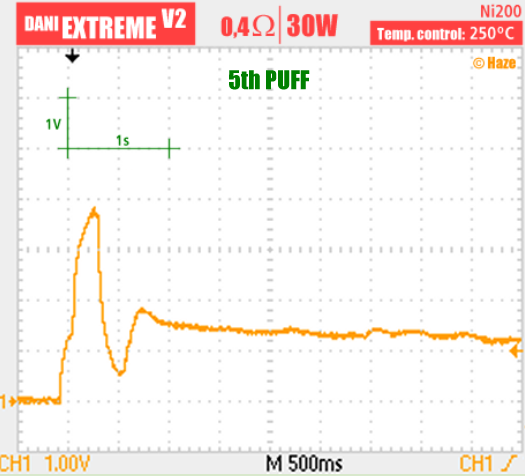
Setup was made as microcoil with NiFe30 wire, 0.7 ohm, 30W and 250*C, the oscilloscope was set for longer acquisition time and GO..


Of course on Ni200 wire is same:


 So, here we can see how the temperature control should look like!
And that's it ... actually no, because:

NOTE: as I know, at this moment Extreme v2 is the ONLY mod with regulated temperature coefficient. We can change it within the range 100-650*C and it mens we can use different temperature wires (NiFe, Ni, Titanium, Wolfram, etc.)


------------------------------


eVic VTC Mini 60W TC 24.09.2015


At first puff:


we can see that is VERY GOOD - no modulation, no oscillations, nice, actually BETTER than DICODES.
Also third puff:


with no comments - quite stable, smooth voltage. Only during 5th puff:


we have a pulse at the beginning, but then is smoothly again. Of course the wick is almost dry.


Generally very handy mod with good TC and very "smooth" voltage shape at VW.

------------------------------


KOOPOR mini 60W TC 16.09.2015


At first puff:


we can see that is VERY GOOD - no modulation, no oscillations, nice.
Also third puff:


with no comments - quite stable voltage. Only during 5th puff:


chip begins to fight ;-) for keeping the proper temperature. Of course the wick is almost dry. 
Finally, with dry wick, the voltage is cut off:


NOTE: in TC KOOPOR mini has mysterious ;-) work modes: SOFT, NORM, HARD. Below you can see how do they look like:


In my opinion the only difference is in amplitude of first peak...

------------------------------


iPV 3 Li 05.09.2015


As we can expect in case of Pioneer4you mod:


we have the PWM modulation. But don't panic ;-)  if we look more accurately:


we can see that the voltage generally "keep the level" - interruptions are very short. Then:


the interrupt time extends:


And finally with almost dry wick we have:


  200ms interruption and barely 20 ms of firing - there is no cloud. Of course so it should be :-)


------------------------------

 
Cloupor GT 80W TC 19.08.2015


First puff, and at sight we can see:


it is VERY NICE. Voltage waveform is "calm", with very small oscillations and no modulation.
Next it is the same:
And when the wick gets dry:


Cloupor GT cut-off the voltage with no much hesitation.

And that's it! It's probably the shortest test which I've done :-) VERY GOOD!

------------------------------

 
Sigelei 75W TC 12.08.2015


It's time to Sigelei, very handy and very solid mod. Let's see what about TC...


As we can see there is quite good: no modulation, only small oscillations unnoticeable during regular vaping. 
At third puff oscillations are a little bigger:


But during fifth one fluctuations return to initial state:


Only at the seventh puff greater battle begins ;-)


Interestingly, Sigelei does not give up like most mods at about 1V - there is no cut-off when the voltage drops below 1V. TC still works even though the voltage must drop to the about 0.5V:


So we have another very well-made mod with good TC feature.


------------------------------

 
Eleaf iStick TC40W 23.07.2015


What can be expected from mod for 30$?? Surely not much... Really? Let's see:


Since first puff we can see that is VERY GOOD! Voltage is regulated smoothly, with no oscillation.
The same is during third puff:


And during fifth puff (and increased observation time) we can see the voltage cut-off after about 10s and dry wick (at ~1V level).


These peaks after cutting off voltage is a standby mode of iStick - it checks every few seconds what is going on with coil:


Thanks to this there is no way to burn dry wick. In some other TC mods it takes some time to cut off the voltage on dry wick, so the wick often burns a little.

So, very cool and neat mod allows to play with the TC for small money.
 (full review soon)


------------------------------


DNA 40 23.07.2015


 The Progenitor of TC. How it works?


No comments at the beginning with wet wick. Then oscillations appear:


Which fortunately disappear after about 1-2 seconds:


When we look at the voltage in the longer run:


DNA takes about a second to examine what happens to the coil, and then starts to descend smoothly with voltage, and at the time when it comes to 1V cut them completely.

NICE


------------------------------


iPV 4 10.07.2015


Knowing that the YiHi chip is inside we know what to expect:


 Right, the PWM modulation. Fortunately if we look more accurately:


we can see that with wet wick the PWM is barely noticeable - 20:1. The voltage interrupt is about 1ms every 20ms - unnoticeable.

Of course with drying the wick the interrupt time extends:


Now we have 1:5 - the voltage is fired for about 20ms, then we have ~100ms interruption. Of course it is fifth puff and wick is almost dry.

At 7th puff and dry wick we have:


 300ms interruption and barely 20 ms of firing - there is no cloud. So it should be :-)


------------------------------


SX mini M-class

The first setup was made with 20 joules and 200*C, the oscilloscope was set for longer acquisition time and GO...


What the hack is going on? Let's expand the range and look at the beginning:


It seems that from the very beginning we have the modulation, and unfortunately it lasts:


Hmmm, not so good ...

Well, let's see more accurate. This time I set the temp. to 150*C, to easier observe the regulation. And the wick HASN'T BEEN SATURATING between successive puffs.

Beginning of the first puff:

 
And further:


You can see that with drying of the wick the modulation frequency is getting down, in other words the chip decreases the RMS (effective voltage) to keep the temperature in check - and this is  OK.
The voltage in a little longer time:


You can see that the intervals between pulses are getting longer with the wick drying.

Well, I checked it in many setups and must say: IT WORKS!

But ... WHY THEY USED THE PWM ?? I expected the voltage will be smoothly changed rather than "jumping" like Vamo ...
And this is the fundamental question - how the others do it?

Soon I will test another mods with temperature regulation and will see.

I also have a measurement NiFe30 wire, I'll put them later however there is no big changes in relation to ni200.

------------------------------

 Now we have The MONSTER ;-) SnowWOLF 200W:


 Let's see what is going on with temperature control...


During the first puff everything is OK, wick is wet so the voltage level is stable:


 Then the wick is getting dry but the Wolf copes with it quite well:


With the wick drying the modulation appears:


Increased when the wick is almost dry:


In my opinion the WOLF is doing better than the SX because it doesn't start so drastic modulation at the beginning.


------------------------------